
Suspension Setup.
Corner Balance.
Alignment Done Right.
Coilover installation, lowering springs, performance wheel alignment, corner weighting, and suspension upgrades — set up for the street, dialed in for the track.
An Alignment Isn't Just Pointing
the Wheels Forward.
It's the Foundation of Everything.
Most alignment shops adjust your toe, hand you a printout, and charge you $80. That's a commodity service for commuters who need their tires to wear evenly. It's not what a performance car needs.
A performance wheel alignment starts with the right target specs for the car's use case — aggressive negative camber for a time attack car, more conservative settings for a street/track dual-use build. It accounts for the suspension modifications on the car: coilovers have different geometry behavior than stock struts, and setting a lowered car to factory specs is actively counterproductive.
Corner balancing goes a step further. Where alignment governs how the tires contact the road, corner weighting governs how the car's mass is distributed across all four contact patches. An unbalanced car pushes harder on two corners than the other two — it will understeer in one direction and oversteer in the other, no matter how good the alignment is. Corner balance is the step between "the suspension is installed" and "the car handles as well as the hardware is capable of." At Iron Ridge, we do both — in the right order.
Four Services.
One Setup That Works.
Suspension performance comes from a system — not individual parts. A coilover installed without a matching alignment is a handling problem. An alignment on an unbalanced car produces inconsistent handling. We do the work in the right sequence.
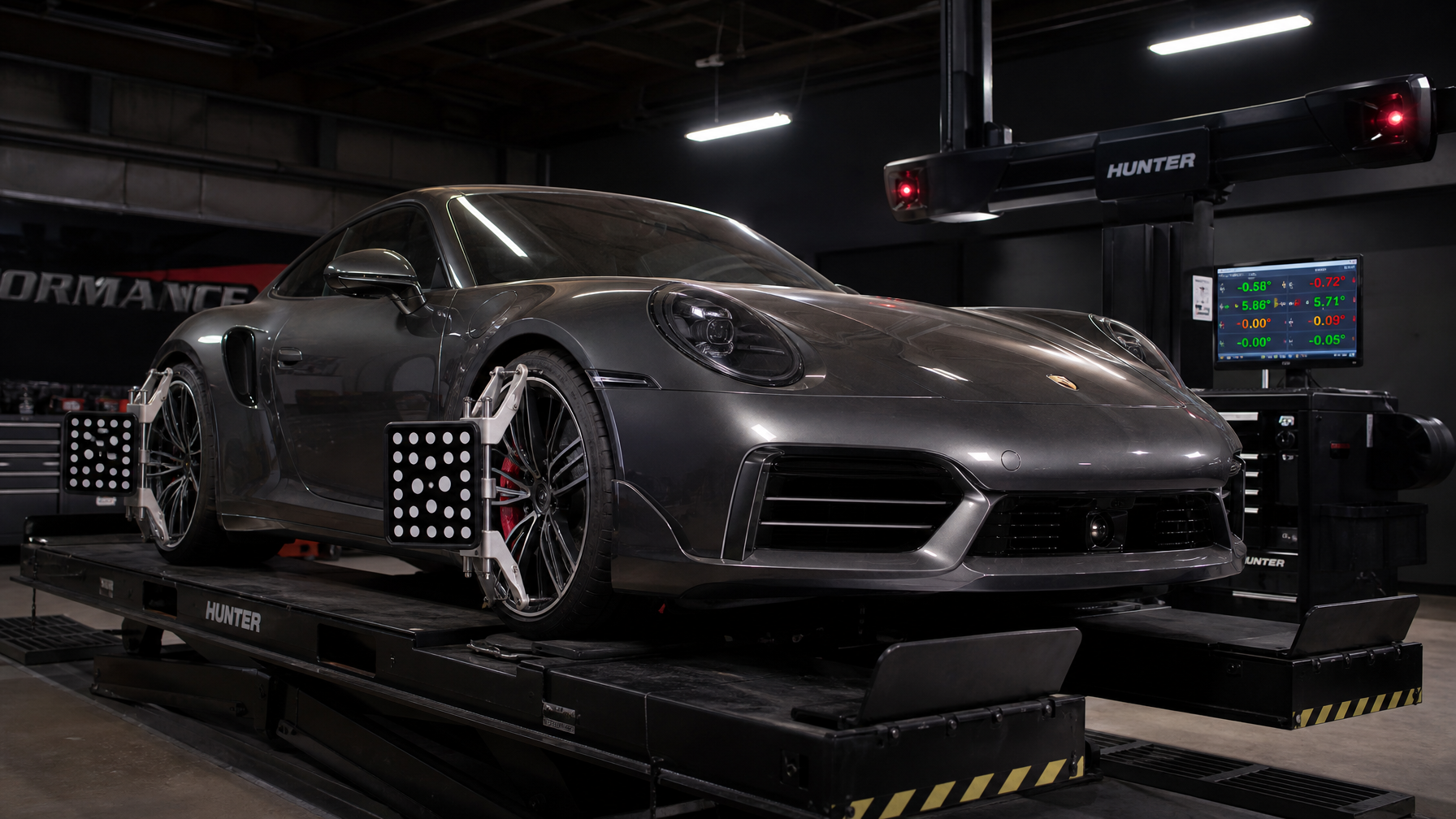
Performance wheel alignment is not the same service as a standard alignment. Target specifications are different, the process is different, and the equipment requirements are different. Standard alignment targets are set to factory specs for unmodified vehicles. Performance alignment targets are set for the car's actual use case — the suspension hardware installed, the track surfaces it will be driven on, and the driving style applied.
For a street/track dual-use build on coilovers, we typically target -1.5° to -2.5° front camber. For a dedicated time attack car, those numbers move further negative, caster is maximized for front end stability, and toe is adjusted for corner entry rotation behavior. We measure every parameter — not just toe — and we set them to targets that make sense for the car in front of us, not the defaults on the machine's dropdown menu.
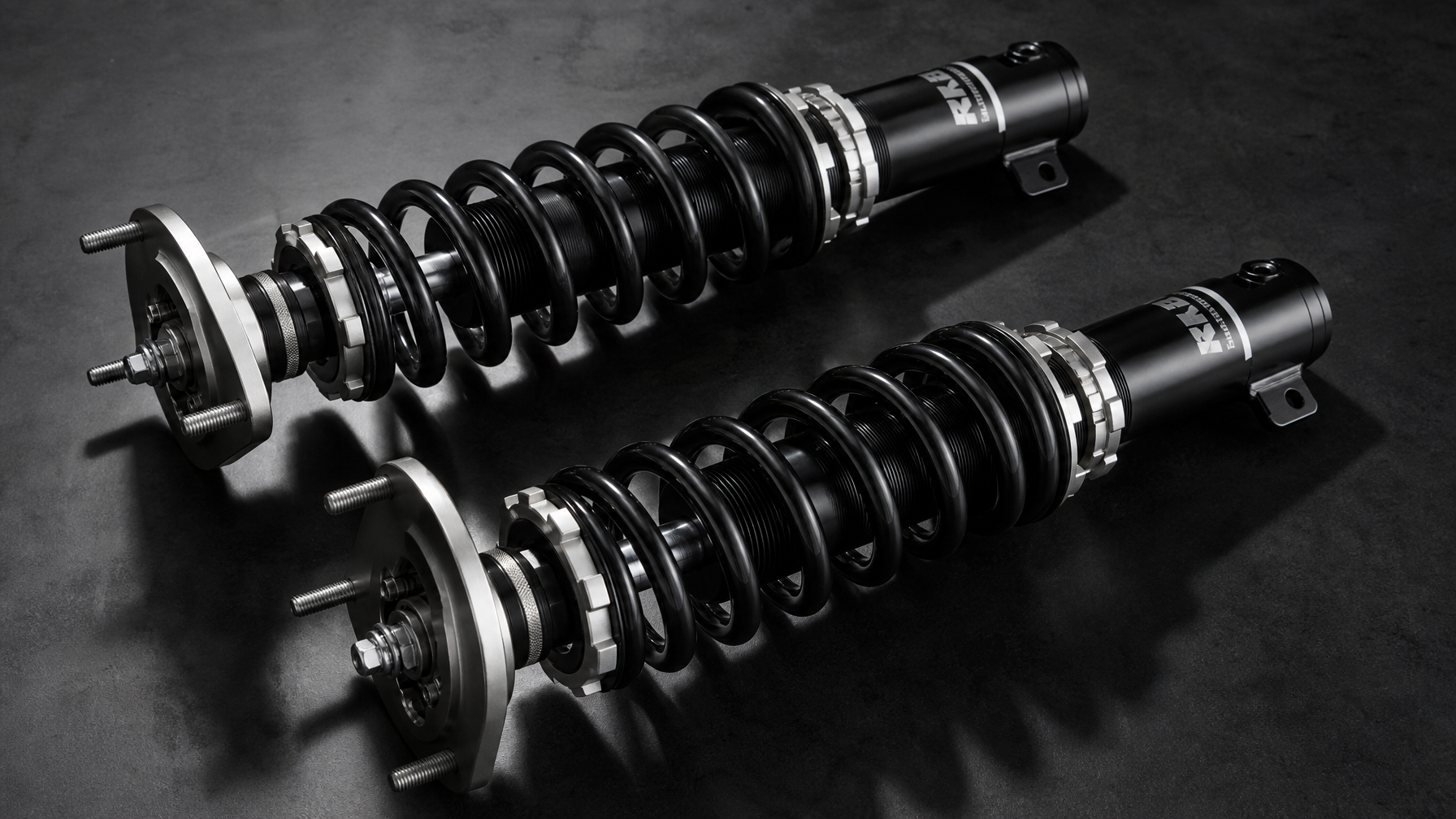
Installing a coilover is not difficult. Installing it correctly — at the right ride height, with the right corner preload, with a post-install alignment that accounts for the new geometry — is a different conversation. We install BC Racing, KW, Bilstein, Tein, Eibach, and Penske. For each install, we start with intended ride height based on the build goal: street/track builds typically target 1"–1.5" below factory, where geometry stays in a functional range.
Lowering springs are a cost-effective option for street builds wanting a modest fixed drop without the full coilover investment. For anything track-oriented or requiring future height adjustment, coilovers are the correct answer. Every coilover and lowering spring install includes a post-install performance alignment — there is no version of a correct installation that skips this step.
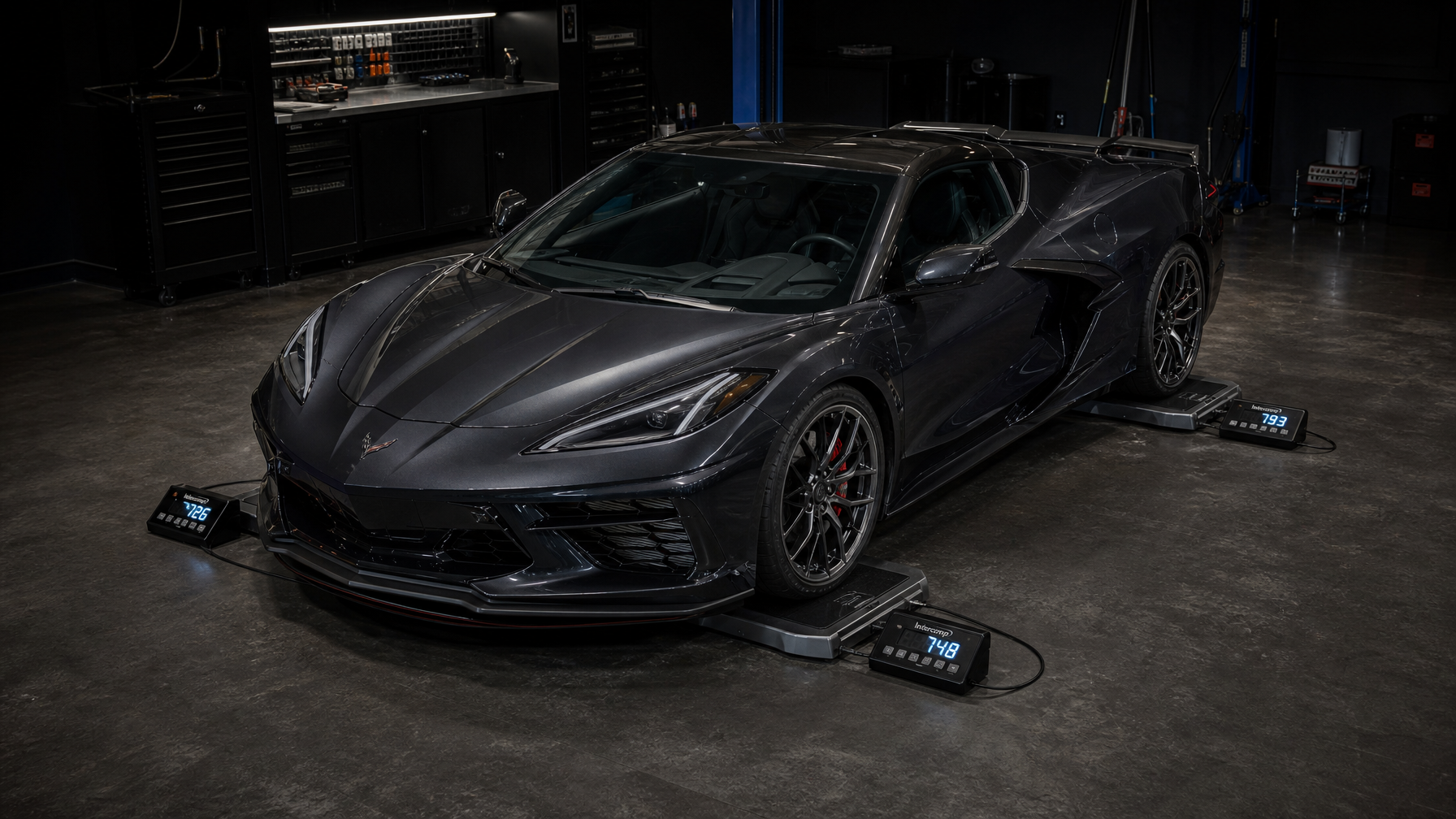
Corner balancing is the most misunderstood and most under-utilized service in performance suspension setup — and it's the one that most directly affects how the car handles at the limit. When cross-weight isn't 50%, one diagonal is loaded harder than the other. Under cornering, the heavily-loaded diagonal generates more grip — producing handling that's different in left and right corners. No alignment adjustment fixes this.
We place the car on a four-corner scale platform, measure weight at each contact patch simultaneously, and adjust individual spring perches on the coilover corners to equalize diagonal weight distribution. Corner balance is performed after alignment, and alignment is re-checked afterward — because adjusting ride height at individual corners changes the alignment geometry. We do both, in the correct sequence, in the same session.
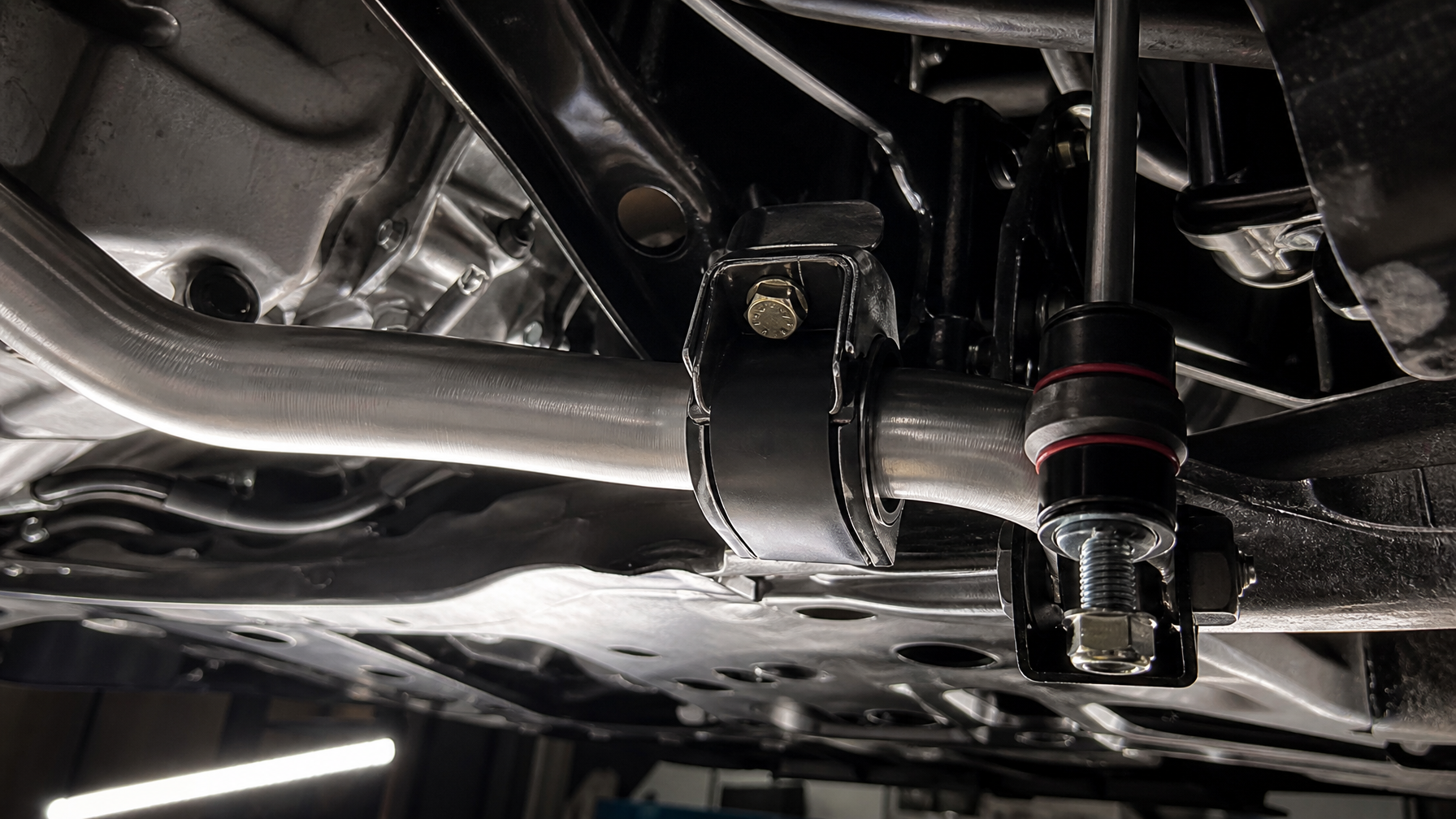
Suspension upgrade isn't always a full coilover replacement. For many cars — particularly trucks, daily drivers, and platforms where the factory architecture is fundamentally sound — targeted component upgrades improve handling without replacing the entire suspension system.
Sway bars are the highest-impact single upgrade for most street cars — a thicker front unit reduces body roll and understeer, while an adjustable rear unit lets you tune the car's balance. Polyurethane bushings replace soft rubber OEM units that introduce slop in the suspension geometry under load. Strut braces and chassis bracing stiffen the local structure where suspension components mount, keeping alignment geometry consistent under the torsional loads of hard cornering.
Coilovers vs Lowering Springs:
Which Is Right for Your Car.
One of the most searched questions in the performance suspension world — and it deserves a direct answer rather than generic hedging.
Replace the factory spring on the existing shock or strut. Lower the car by a fixed amount (typically 0.5"–2") and increase spring rate over stock for a firmer, more controlled ride. Significantly less expensive than coilovers, require less installation time, and on many platforms produce an excellent result for a modest street build.
On higher-mileage cars, we recommend replacing shocks at the same time — the shock's valving may not match the upgraded spring rate, producing a harsh and poorly-controlled ride even with quality springs installed.
Replace the entire strut or shock/spring assembly with a single integrated unit. Ride height, spring preload, and on quality units, damper compression and rebound rates are all independently adjustable. The car can be set for a track day weekend, then re-set for commuting — without changing parts.
For any car that will see track use, adjustability isn't a luxury — it's the difference between a setup that's acceptable everywhere and one that's actually optimized. Coilovers also enable corner balancing, which lowering springs cannot.
The simple guide: Street daily driver, modest drop, fixed use case → quality lowering springs on new shocks. Street/track dual-use, any track use, or any build where future adjustment is possible → coilovers. Dedicated track or time attack car → coilovers with adjustable dampers (KW V3, Penske, or equivalent). The additional investment pays back in the setup capability the track demands.
Why Corner Balance Is the Step
Most Shops Skip.
And Why It Matters.
Corner balance is the step between "the suspension is installed correctly" and "the car is set up correctly." It's offered by almost no street-focused alignment shops, understood by a small fraction of enthusiasts who haven't built a track car, and completely standard practice in every form of sanctioned motorsport.
A car sitting on four contact patches distributes its total weight across those four points. The cross-weight — the sum of the left-front and right-rear weights as a percentage of total weight — determines whether the car handles symmetrically. When cross-weight isn't 50%, one diagonal is loaded harder than the other. Under cornering, grip at each tire is roughly proportional to vertical load. An unbalanced car generates unequal grip on its cornering diagonals — producing handling that's different left versus right. No amount of alignment adjustment fixes this.
We adjust spring perch height on individual coilover corners — raising a corner increases its load, lowering it reduces load — and iterate until cross-weight is within 0.5% of target. Then we re-check alignment, because height adjustments change geometry. This is the step most setups skip. It's also the step that makes the biggest difference in a track car's consistency.
Camber, Caster, Toe,
Corner Weight —
What Each One Does.
You've heard these terms. Here's what they actually control in the car's handling — and why they need to be set in relation to each other, not independently.
Camber is the tilt of the tire relative to vertical when viewed from the front. Zero degrees means the tire is perfectly upright. Negative camber means the top of the tire leans inward. Under lateral cornering load, the suspension compresses and the car rolls — tilting the tire away from its optimal contact patch. Pre-setting negative camber counteracts this roll, keeping the contact patch flat during cornering. Too much reduces straight-line traction and accelerates inside edge wear. The correct amount depends on spring rate, suspension travel, and the lateral load the car generates — which is why track cars run more negative camber than street cars.
A performance alignment targets camber based on the car's use case, not the factory dropdown spec. We measure it, then set it with purpose.
Caster is the angle of the steering axis relative to vertical when viewed from the side. Positive caster — the top of the steering axis tilting rearward — improves straight-line stability, increases steering feedback, and has a beneficial camber gain effect during steering: as the wheel turns, the geometry naturally adds negative camber to the outside tire, which is exactly what you want during cornering.
Most performance alignment specs target maximum positive caster within the platform's adjustment range. On many OEM platforms, caster is not easily adjustable without additional hardware — caster adjustment bolts, eccentric bolts, or caster correction plates. We check caster on every alignment and note when it's outside the usable range with available hardware.
Toe is the angle of the tires relative to the car's centerline when viewed from above. Toe-in means the fronts of the tires point toward each other. Toe-out means the fronts point away. Toe has the most immediate effect on tire wear — misaligned toe wears tires rapidly — and on corner entry behavior. Rear toe-in increases stability under braking and on corner entry. Rear toe-out increases rotation for trail-braking techniques. Front toe adjustments affect turn-in response: a small amount of front toe-out improves initial steering response but reduces straight-line stability slightly.
We set toe last — after camber and caster are established — because toe interacts with both. Toe is the most sensitive geometry parameter: 0.1° of toe error generates measurable tire scrub over a driving cycle.
Corner weight governs how the car's mass is distributed across the four contact patches. Cross-weight — the diagonal pair relationship — determines whether the car handles symmetrically in left and right corners. It is set by adjusting the ride height at individual corners on the coilover perch, not by changing alignment settings.
A balanced car with 50% cross-weight produces consistent handling behavior in both directions. An unbalanced car generates different grip levels on left-turn and right-turn corners — the driver must compensate for the car rather than rely on it. Corner weight is the last step in a complete suspension setup — after hardware installation, after alignment, after ride height is confirmed — because it fine-tunes the load distribution across the system that alignment has already optimized. Corner balance is only possible on cars with individually adjustable ride height: coilovers.
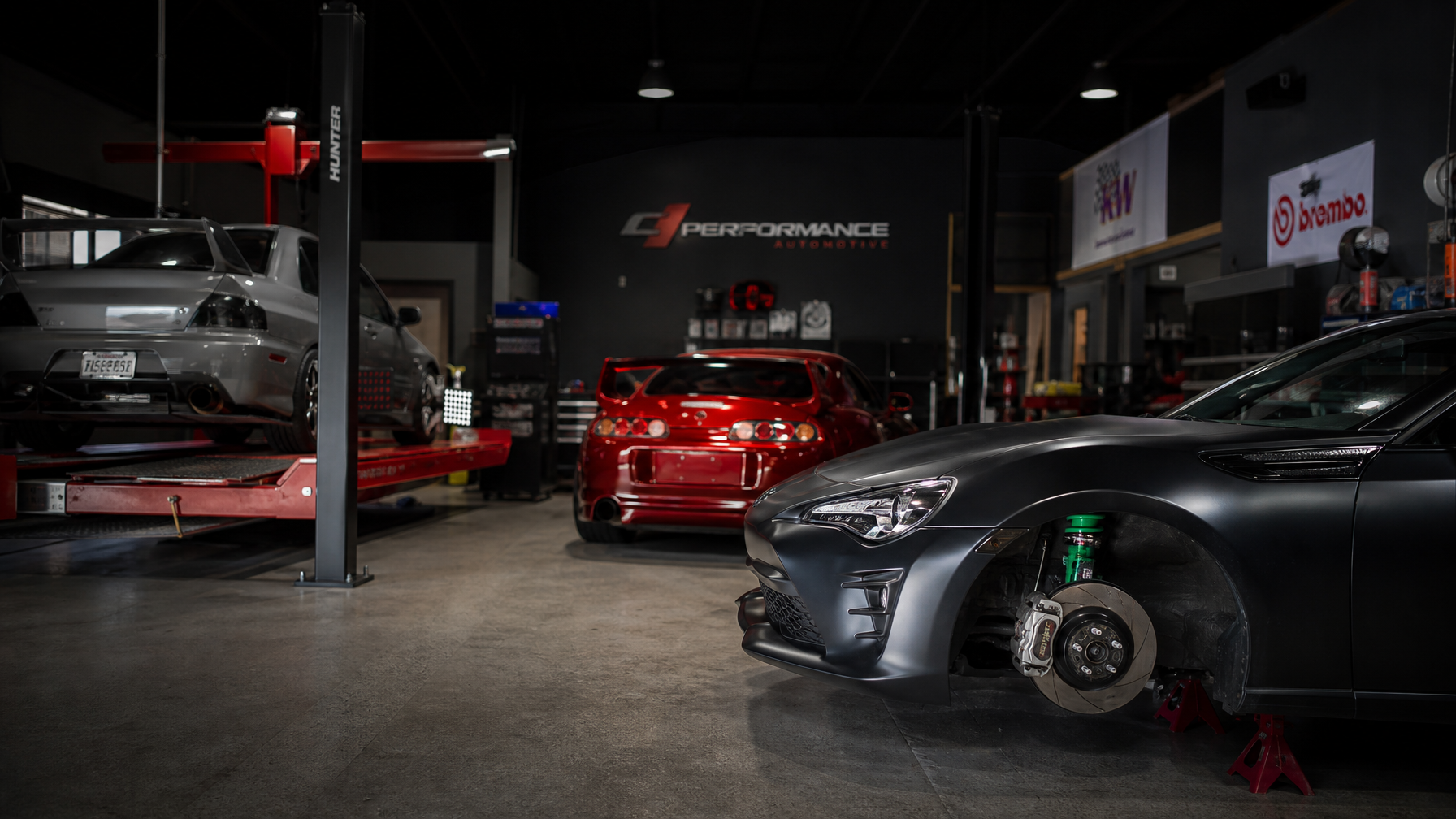
We Know How Your Platform
Should Behave at the Limit.
Every platform has a different suspension architecture and different setup requirements. Here's how we approach the builds we see most often in Houston.
The VQ35-powered 350Z is one of the most popular time attack platforms in the country — its double-wishbone front / multi-link rear responds exceptionally well to setup work. Factory alignment specs are conservative. The 350Z benefits from increased negative front camber and rear camber correction to match. Coilover selection should account for the car's tendency to develop understeer at the front under hard cornering — spring rate balance between front and rear, combined with rear sway bar tuning, is how you unlock the neutral handling the platform is capable of. Corner balance on a 350Z time attack build is mandatory — the factory weight distribution is rear-biased and the suspension is sensitive to cross-weight changes.
The GR86 platform is arguably the best factory-balanced sport car at its price point — and it responds dramatically to suspension setup because the factory geometry is already close to optimal. Track-setup GR86s typically run -2.5° to -3.5° front camber, increased caster, and a rear sway bar upgrade to balance the car's mild factory oversteer tendency at the limit. Corner balance on the GR86 is particularly rewarding — many drivers report this is the single most impactful step in the GR86 setup process, producing a noticeably more symmetric handling character in both directions.
The WRX and STI run a MacPherson front and multi-link rear, with AWD geometry considerations that make alignment more complex than RWD platforms. The STI's rear multilink is particularly geometry-sensitive — rear camber and toe settings interact with AWD center differential behavior under throttle. Getting these wrong produces rear-end instability under hard cornering with throttle applied. STI builds going to the track need aggressive front negative camber, corrected rear camber to match, and precise rear toe settings. The combination of COBB ProTune and proper suspension alignment produces a car that's significantly faster than either upgrade alone.
BMW's double-wishbone front and trailing arm / Z-axle rear makes these among the most rewarding platforms to set up for performance driving. Factory specs are appropriate for 1990s German roads, not modern performance driving. Coilover selection for the E36/E46 should prioritize quality damper valving over spring rate — the platform's inherent balance rewards a suspension that can be damper-tuned through different conditions. The E9X M3's more modern multi-link architecture has tighter geometry constraints — camber plates or adjustable control arms are often required to achieve target specs on lowered cars.
The MQB platform has different setup requirements depending on the variant. The GTI's rear twist-beam is not independently adjustable for camber — ride height changes on the rear require camber correction at the front to maintain balance. The Golf R and A3 Quattro's multi-link rear allows independent camber adjustment, opening up more setup options for track use. Both respond well to coilover installation combined with front and rear sway bar upgrades. The factory GTI sway bars are notably compliant — even a moderate aftermarket unit produces a perceptible improvement in roll stiffness and cornering balance.
Truck suspension upgrades serve a different purpose — improved handling under load, reduced body roll during towing, better highway stability, and clearance. The F150 IFS responds well to sway bar upgrades — the factory front unit is notably compliant, and an aftermarket unit from Eibach or Whiteline reduces body roll significantly without stiffening the ride. For lifted applications, alignment correction after lift installation is mandatory — lifted trucks with uncorrected caster and toe settings destroy tires rapidly. The RAM 1500's rear leaf spring setup is a common target for add-a-leaf or replacement spring upgrades that reduce squat under tow.
Hardware to
Corner Balance.
In the Right Order.
Suspension setup has a sequence. Doing it out of order produces a result that's worse than the sum of the parts. Here's how every complete setup goes at Iron Ridge.
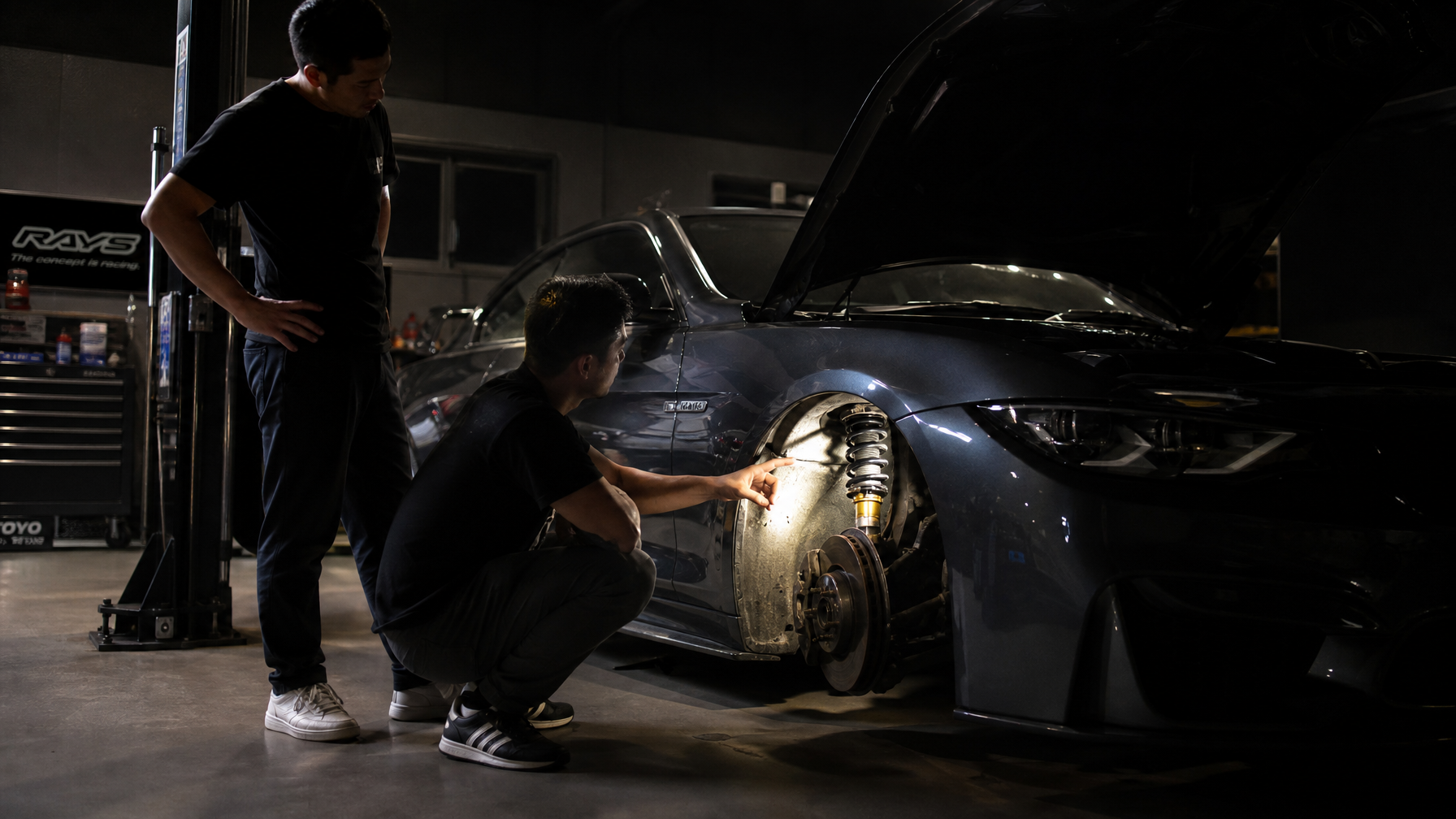
Before a single component is selected, we establish what the car needs to do. Street daily driver with a modest drop is a completely different build from a weekend track car targeting competitive lap times. The coilover, spring rate, alignment target, and whether corner balance is in scope all flow from this conversation. A coilover right for a daily driver — compliant valving, modest spring rates, ride height range that works on rough roads — is the wrong coilover for a time attack car. We establish this before quoting parts.
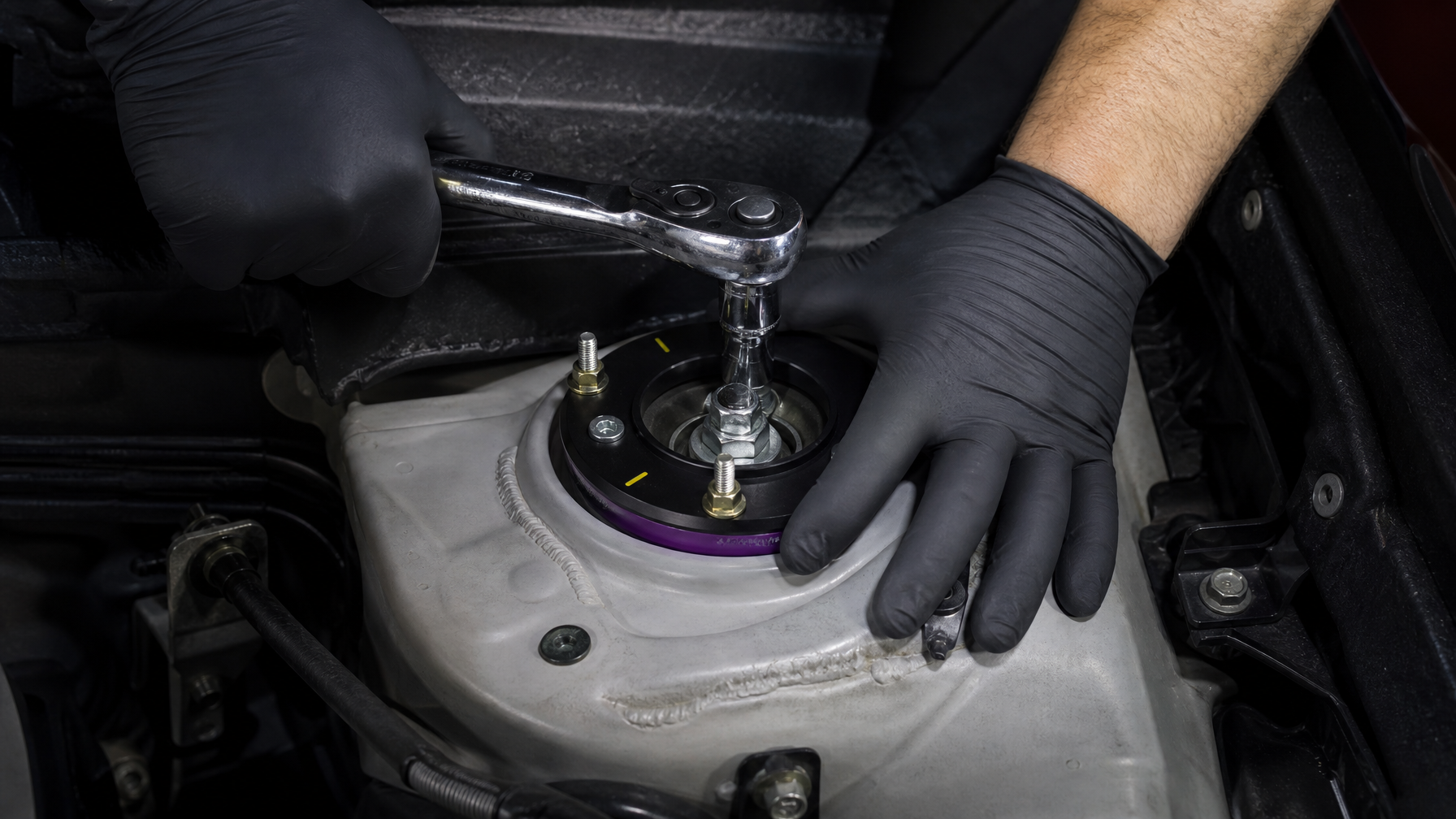
We source from BC Racing, KW Suspension, Bilstein, Tein, Eibach, Penske, and Ohlins for coilovers; Eibach, H&R, and Swift for springs; Whiteline, Eibach, and Hotchkis for sway bars and geometry components. Installation includes setting initial ride height to target — typically 1"–1.5" below stock for street/track builds — with the understanding that this will be refined during alignment and corner balance. Supporting components (upgraded end links, camber plates, alignment bolts) are installed at the same time to avoid a second teardown later.
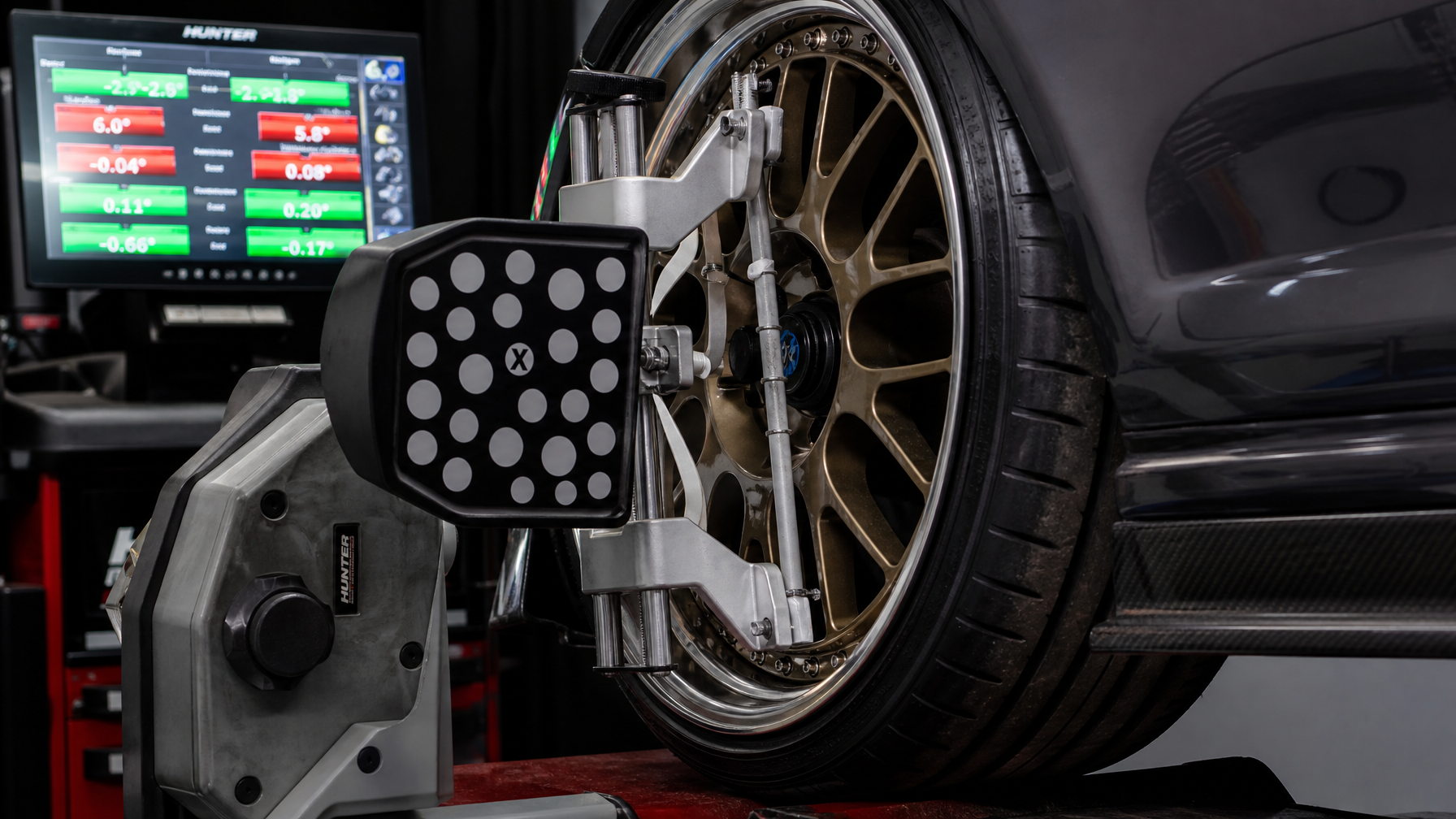
With suspension installed and ride height at initial target, the car goes on the alignment rack. We measure all four-wheel geometry — camber, caster, toe front and rear — and set to use-case appropriate targets. If the platform requires additional hardware to achieve target specs (camber bolts, adjustable camber plates, caster correction), this is identified at this stage and addressed before the alignment is signed off. The alignment is documented and a printout is provided showing before and after values at every parameter.
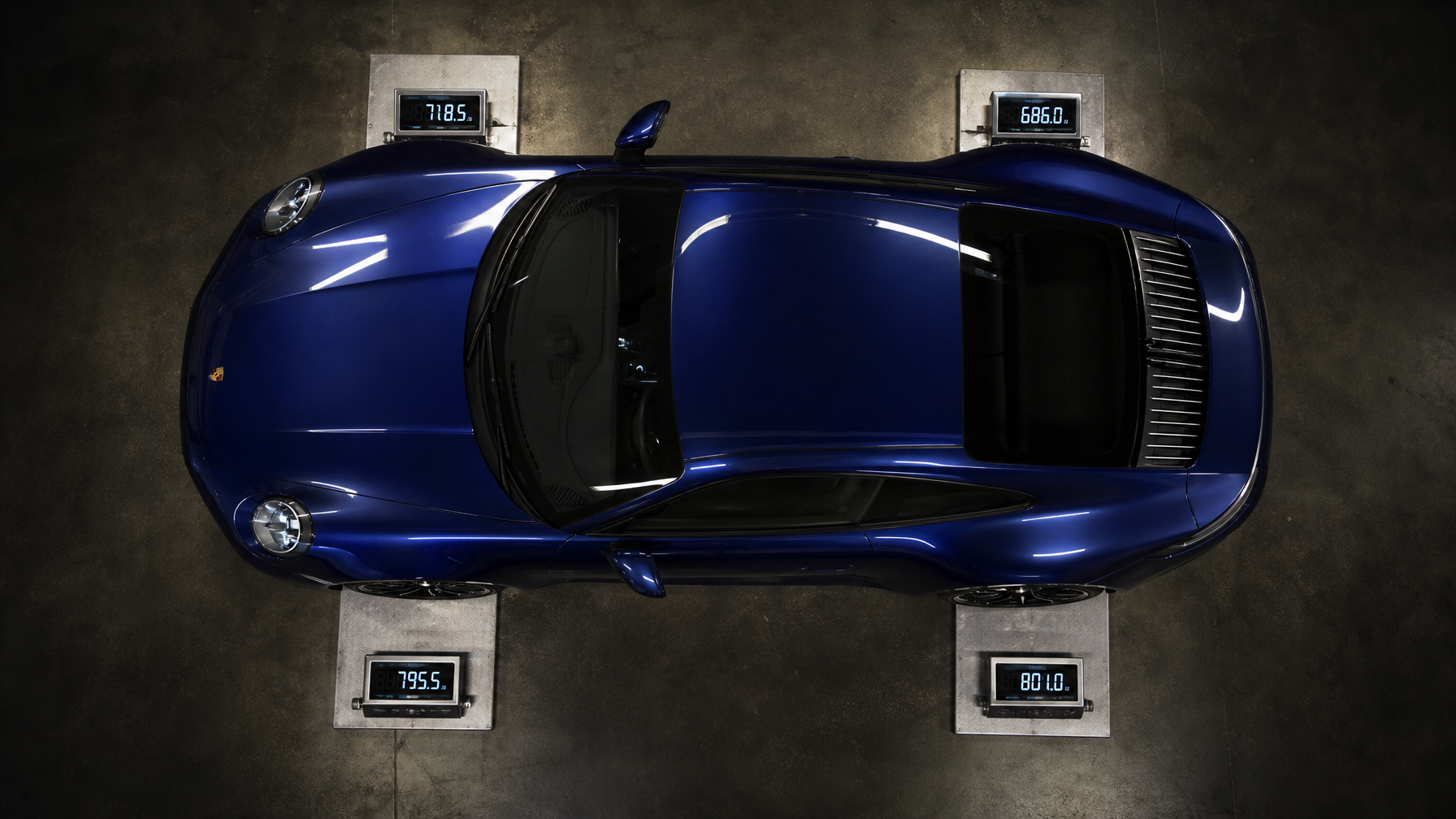
For track and performance builds, corner balance follows alignment. The car goes on the four-corner scale platform with driver (or ballast) in position, fuel at race level. We measure cross-weight, adjust individual spring perches to reach target (50% for neutral balance), and re-check alignment after the height adjustments. The final alignment check confirms geometry is still correct after the corner balance adjustments — this is the step most setups skip, and it's the difference between a balanced car and a balanced car that also handles as intended. The car leaves with a complete setup sheet: alignment values and corner weights documented.
Houston's Performance Alignment Shop
That Actually Understands Suspension.
Most alignment shops set your car to factory specs and hand you a printout. We set it to specs that make sense for the car's actual hardware and use case — then corner balance it if the build warrants it.
We don't default to factory alignment specs on modified cars. A car on coilovers at 1.5" below factory ride height has different geometry behavior than the factory setup the specs were written for. We establish the correct target for the hardware on the car and the use case it's built for — then set the alignment to hit it. Track targets, street/track targets, and daily driver targets are all different conversations.
We have four-corner scale platform capability for corner balance and cross-weight optimization. This is a service offered by almost no street-focused alignment shops in Houston and is standard practice in every form of sanctioned motorsport. If you're building a car for track use and you haven't corner-balanced it, you're leaving measurable performance on the floor.
We install hardware, set ride height, align, then corner balance — in that order, with an alignment re-check after corner balance. This is the sequence that produces a setup that works as a system. Skipping steps or doing them out of order produces a car that's partially optimized at best, and one that handles inconsistently at worst.
We know the 350Z's understeer tendency and how sway bar balance addresses it. We know the GR86's sensitivity to cross-weight adjustment. We know the STI's rear geometry interaction with AWD differential behavior. We know the E46 geometry and what camber hardware is required for track-spec settings on a lowered car. Platform experience, not generic theory.
We tell you which coilover is right for the specific combination of platform, use case, and budget before the order is placed. The right KW for a dedicated track car and the right KW for a street/track dual-use build are not the same product. The right BC Racing for a budget regional competitor and the right Penske for national-level time attack are not in the same category. We make this call before money is spent.
We build engines, install forced induction, tune on the dyno, and set up suspension. A car we've tuned and then set up on suspension is a car we understand as a complete system — the tune influences the suspension setup. High-power builds with particular torque delivery characteristics have different spring rate and damper requirements than lower-power cars. Context carries through when it's all done in one shop.
Suspension & Alignment FAQ
The questions we answer before every setup. Real answers — no filler.
Ready to Set Up Your
Car Properly?
Tell us your platform, what's on it, and whether it's going to the track. We'll scope the setup that makes sense.
Tell Us About Your
Suspension Project
Let us know the car, what's on it, and what you're trying to accomplish. We respond within one business day.
We review every submission and respond within one business day. No spam, no pressure — just a real conversation about your setup.

IRON RIDGE MOTORSPORTS


